
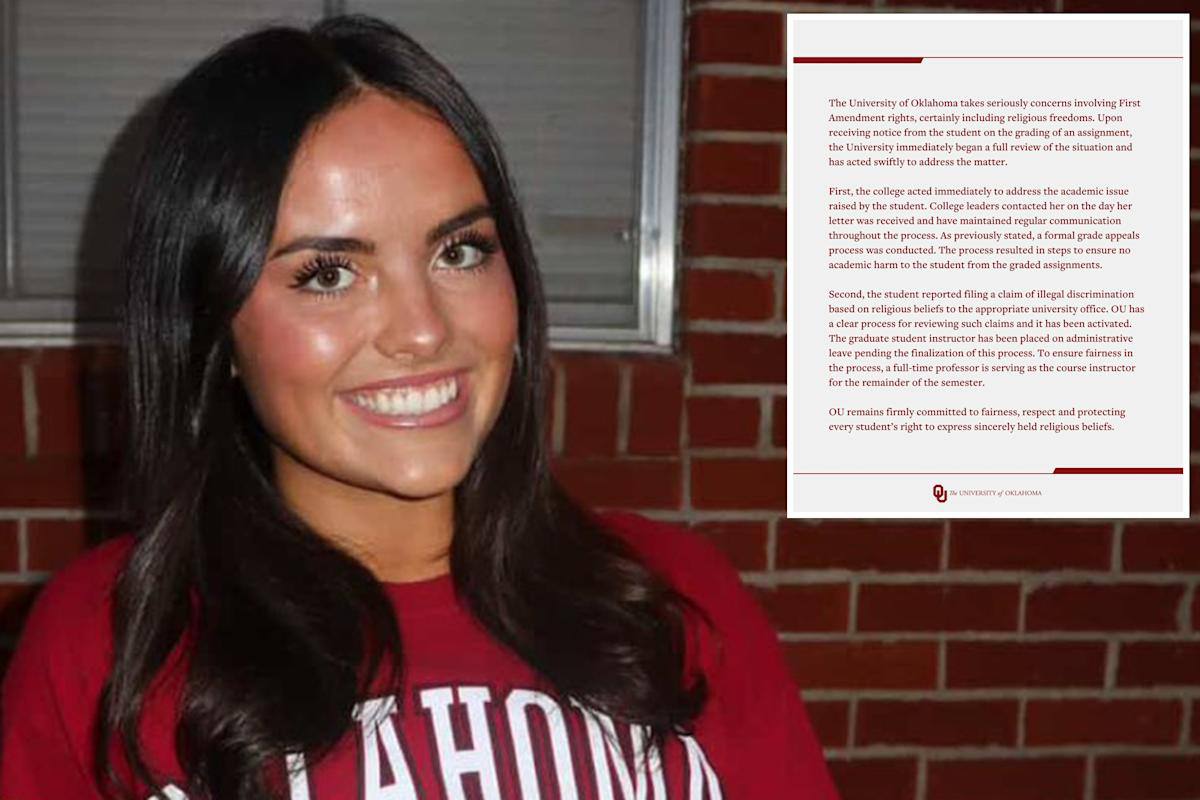
A graduate assistant at the University of Oklahoma has been placed on administrative leave after a student alleged religious discrimination when her essay — rooted in Biblical teachings on gender — received a failing grade.
Samantha Fulnecky, a student at the university, submitted an essay for her psychology class that was meant to analyze “how people are perceived based on societal expectations of gender.”
The assignment required students to respond directly to a specific article on gender stereotypes.
Instead of examining the assigned reading, Fulnecky wrote roughly 650 words focusing primarily on Biblical views of gender roles.
Throughout the essay, she repeatedly stated that she does not object to gender stereotypes because “that is how God made us.”
The course was taught by graduate student Mel Curth, who uses “she/they” pronouns. Curth issued a failing grade, explaining that Fulnecky did not follow the assignment guidelines and relied on “personal ideology” instead of “empirical evidence.”
According to information shared by a student organization, Fulnecky also did not properly cite or engage with the required article.
Her only reference to the reading was a brief mention of “teasing as a way to enforce gender norms.”
Most of the essay centered on her belief that children are harmed by the idea of multiple genders.
It is unclear whether this topic was part of the assigned article.
“Society pushing the lie that there are multiple genders and everyone should be whatever they want to be is demonic and severely harms American youth,” Fulnecky wrote.
“I live my life based on this truth and firmly believe that there would be less gender issues and insecurities in children if they were raised knowing that they do not belong to themselves, but belong to the Lord,” she continued.
Curth upheld the failing grade and told Fulnecky that portions of the essay were “at times offensive.”
“To call an entire group of people ‘demonic’ is highly offensive, especially a minoritized population,” Curth wrote.
The instructor also pointed to contradictions in the student’s argument.
“You can say strict gender norms don’t create gender stereotypes, but that isn’t true by definition. And acknowledging stereotypes does not automatically imply negativity — a nuance discussed in the article,” Curth added.
Curth advised Fulnecky to apply “more perspective and empathy” in future coursework and noted she was welcome to share criticisms “in a way that is appropriate and rooted in empirical psychology.”
A second instructor, Megan Waldron, who teaches a parallel section of the same class, reviewed the essay and supported Curth’s decision.
Waldron expressed concern that Fulnecky did not view bullying or teasing as harmful behavior.
“Your paper directly and harshly criticizes your peers and their opinions, which are just as valid as yours. Disagreement is fine, but there is a respectful way to express it,” Waldron wrote.
The University of Oklahoma released a statement confirming that a “graduate student instructor” had been placed on administrative leave.
The university said it is investigating allegations of unlawful discrimination “based on religious beliefs.”
The statement did not name Fulnecky, Curth, or Waldron, and it is unclear whether both instructors were removed during the investigation.